User:NewOriginalSchwann/Sandbox3








| Caria |
| Paegilini System |
_wiki_edit.png) |
| Sector: Sparring Sea |
| Capital: Yaskarit |
| Species: Humans |
| Common Languages: Vulgar Morozi, High Morozi |
| Demonyms: Carian |
| Part of: Empire of Dominia |
| Formerly part of: Sol Alliance |
In the far-flung Paegilini System lies a strange, tidally-locked world of the Empire of Dominia: the Imperial Viceroyalty of Caria'. Controlled by the Empire since 2424 and often referred to with the derisive nickname of the “Witch World,” it is a world shrouded in darkness and rumors. The planet serves as the Empire’s gate to the Eastern Military Frontier and its hand is soft here, allowing for the local oligarchy to thrive — though some conservatives have called for it to be reigned in. Its inhabitants are known as Carians and are often regarded with suspicion abroad due to their planet’s mysterious nature. They adhere to an acceptable deviation of Tribunalism known as Carian Tribunalism and are renowned for their abilities as seers and diviners within the broader umbrella of Moroz Holy Tribunalism.
| Contents |
|---|
History
Prehistory (Circa 2190 - 2375
The pre-Imperial history of Caria is poorly documented. Attempts by Imperial and – more recently – Solarian researchers to uncover its past have been frustrated by a lack of available records about the planet written before Elyra’s secession in 2302. It was most likely colonized at roughly the same time as Novi Jadran and Sun Reach, in the late 22nd century, and intended to be a habitation or scientific center in the Baltian and Arcadian Frontier Sectors due to its strange environment and ideal position between Sun Reach and inhabitable worlds further into the frontier. A Solarian Department of Colonization report from 2205 notes it as a research-focused colony and transit hub, but does not contain any further information. The lack of formal information from this era has led to Imperial scholars referring to it as “Prehistoric Caria” and have settled on referring to the planet as a Solarian scientific colony, based on what information is known about it from historical records and Carian genetic code showing signs of past genetic tampering associated with Hegemonic-era Solarian experiments to produce more adaptable colonists.
Carian academics have similarly fractured records which are often mixed with legends, half-truths, and oral histories. Officially they do not deviate from their Imperial counterparts in calling the planet a Solarian research colony. In their mythology Carians state they were brought to the planet by the Alliance, which abandoned them when its planetary rotation locked into place, and were saved by the geothermal vents modern Carian cities are now built around. According to modern dating by the Imperial Jadranic Academy of Sciences, Caria’s vents are thousands of years old and have been held by more conservative Tribunalist scholars as an example of the Goddess planning out the history of the Spur far in advance. Prior to the Imperial era, these mythologies substituted the Goddess for the Great Mother – or Aderlai – a local deity associated with Caria who possesses superficial resemblances to the Goddess.
The poor amount of information on prehistoric Caria has led to numerous theories about the Witch World’s true origins. Some in the Holy Tribunal claim the colonists, like Morozians, were brought to the world to serve a special purpose, as She has ordained, and their unique nature is a sign of Her blessing. Others claim malevolent witch-spirits moved the planet known for its connection to sorcery from the depths of the Lemurian Sea – or beyond the Spur – to the modern Empire through vile witchwork for purposes unknown – but undoubtedly nefarious. Yet others claim the Carians are the end result of Solarian hegemonic-era experiments with the nature of humanity, and go beyond the limits of conventional human beings. The inoperative and broken remnants of warp gates in its system attest to the possibility of form of Solarian warp drive experimentation during their era of control, but the secrets of Caria’s past may never be truly known.
The Pirate Lords
Well-recorded and attested Carian history starts in 2375, with the planet’s subjugation by the Pirate Lords of Sun Reach. The Lords used the world, which had by then developed its own local oligarchical government, in much the same way the Empire would: as a transit world between Sun Reach and their domains beyond Caria. This, and the soft hand of the Lords, caused the planet to benefit more from their control than perhaps anywhere else due to trade profits. By the late 24th century, the families that ruled Caria on behalf of Sun Reach were wealthier, more influential, and more independent than their overlord would have liked them to be. Rumors in the Adirim, Caria’s government, began to circulate that the Pirate Lords were planning to punish their most successful underlings and take over their trade empire themselves.
But any censure of Caria’s oligarchical families would never come thanks to its growing conflict with Novi Jadran: an insignificant, frozen world home to a surprising amount of industry which had – out of frustration with constant raids on their world by Sun Reach – sworn loyalty to Moroz, a distant, nearly as frigid world of little importance to the Adirim or Carians more broadly. The Pirate Lords’ decisive and rapid defeat in Sun Reach in 2422 shocked the planet and threw it into a temporary panic as patrician families sold off what assets they could and prepared for an inevitable Dominian assault on their world. The local military – a shadow of what the Pirate Lords had, let alone the Empire’s military – rapidly dissolved in fear of what was to come.
When Imperial forces entered into the Paegilini system on 7 July, 2424, they were greeted by a planet on the verge of surrender. A look at the forces arrayed against Caria by the Empire led its leader, Grand Estate-Holder Bomilcar Magonbaal, to surrender immediately to the Imperial Fleet, which landed in the planetary capital and raised the Emperor’s standard in an official ceremony. The only shots fired in the Dominian invasion of the planet were in a ceremonial salute, and by a startled Dominian Imperial Fleet armsman at a migrating animal.
Imperial Era
As when it was controlled by the Pirate Lords, Caria and its government have thrived under Dominian rule. The mostly peaceful nature of its transfer to Morozian rule led to little damage to the Carians, with most disruptions coming from a shift between the native religion of the planet, known as Carianism to Dominians and the 'Hatim Aderlai-Zlim' (lit. “Blood Path of the Great Mother”) to the pre-Imperial population, to Carian Tribunalism. Strategically, the planet’s role as a gate between Sun Reach and the broader region has not shifted, with House Caladius vessels replacing those of the Pirate Lords and colonial bureaucrats having replaced tribute collectors.
Beneficially, Caria never faced the infrastructure and urban decay of Sun Reach, nor the privations of Novi Jadran, enabling it to bargain from a stronger position when it submitted to the Empire. While they lost their native faith to Tribunalism, canny maneuvering – which some claim involved sorcery – saw the Adirim and the Grand Estate-Holder remain in charge under the nominal oversight of a colonial Governor-Viceroy. The massive investment projects which changed life patterns on Sun Reach and Novi Jadran did not occur on Caria, and the planet has retained a level of autonomy alongside its prosperity. This has led to its non-trade economy being less integrated with the Dominian colonial economy, aside from the entry of Dominian textile products into a market once dominated by more expensive local Carian output.
But despite its relative wealth from trade and freedom, not all is well upon the Witch World. Rumors of its sorcerous connections and the odd appearance of Carians cause them to often be discriminated against abroad in the Empire, with Imperial citizens blaming them for inexplicable phenomena when they are near and accusing them of trafficking with dark forces. In the Sparring Sea, where their trade networks are, tensions between the Republic of Elyra and Empire are higher than ever, and any war between the two will place them uncomfortably close to the frontlines and destroy many of their trade ventures. On Moroz, conservative nobles and clergy call for their autonomy to be restrained and their divination practices to be curtailed. And in Yaskarit, its capital, the Adirim is divided and volatile, with patrician families willing to use any dirty trick they can muster to win influence and power – even at the cost of the broader planet.
The Paegilini System
Named for its star – Paegilini – Caria’s system has no signs of habitation prior to humanity’s arrival, and is filled with the deactivated, disassembled, and destroyed remains of Solarian hegemonic-era warp gates known locally as the Tanit Gates, most of which orbit around Caria and its moon. The system is home to four major celestial bodies and one notable moon.
- Leptis: The innermost planet of the system. A hot, barren rock with little in the way of mineral resources or stellar artefacts, it has remained mostly untouched aside from the remains of hegemonic-era and – more recently – House Volvalaad scientific probes. It has no atmosphere and the constant bombardment of Paeglini’s rays make long-term habitation impractical.
- Caria: The crown jewel of the system and home to its population. It is a tidally-locked world lit by its moon, where the population lives on the side opposite of the sun.
- Lixus: The only moon of Caria, its surface is made of highly-reflective material which provides the dim light the planet’s Shrouded side is known for. Lixus was a sacred site in Carianism – the officially extinct pre-Imperial faith of the planet – and is considered to be a protected site by the Imperial colonial administration due its importance for continued life on Caria’s surface. All activities here not approved by both the governor-viceroy and grand estate-holder are banned, with the Imperial Fleet responsible for prosecuting those who violate this regulation.
- Tanit Gates: Mostly found in Caria’s orbit, these are manmade objects from the hegemonic era which resemble pre-24th century Solarian warp gates. Over the centuries most have fallen into disrepair due to damage from stellar objects or part-stripping by salvagers. However, a few gates have been preserved in Caria’s orbit and are being eagerly studied by House Volvalaad and scholars they have invited from the Solarian Alliance. No Tanit Gate has ever been recorded as active.
- Beyond Caria and Lixus the system’s major bodies are Motya, a gas giant where Carian vessels have long mined resources in its rings, and Abdera: a distant, icy dwarf planet categorized by the Imperial Institute of Astrography as marginal, despite its mineral wealth. Zhurong’s ore veins are simply more valuable and easier to mine than a distant, cold rock.
Environment
A tidally-locked world, Caria is divided into two hemispheres known as the Sunward and Shrouded halves of the planet. The Sunward side of Caria is an uninhabitable desert constantly baked by the rays of the Paegilini Star and has no permanent settlements. The only structures are ruins of automated mining facilities from the Solarian era, half-buried by the sand which dominates much of Sunward Caria’s surface. Many of these facilities have laid untouched since the early 24th century. The Sunward dunes may hide even more secrets, but expeditions onto this side of the planet have proven costly, dangerous, and difficult for little returns. Animal and plant life on this side of Caria is rare, with most species limited to very small insects or burrowing creatures which live near underground sources of water and plant life. Surface water is unheard of, and will quickly evaporate in the event of rain. Certain animals which reside on or near the Sunward surface exhibit anhydrobiosis and can live for years to decades without water. House Volvalaad has expressed some interest in these creatures and is one of the few entities to support further research into this side.
Transitional zones dominate the thin line spanning the area between the Sunward and Shrouded sides. Like the Sunward side, these zones are desert-like and feature little in the way of life or surface water. However, they are also generally colder than the Sunward side due to not being cast in the star’s direct light.
Shrouded Caria is where the planet’s population resides. Lit by the reflective glow of Caria’s moon, Lixus, it is a dim, cold, and barren landscape where life is concentrated around large geothermal vents which warm the area around themselves. The Carian population is densely concentrated in major cities around these vents and their surrounding territories, locally known as the eraset of a city. Outside of these vents surface conditions are tundra-like, dominated by cold temperatures and covered by small chemotrophs which are able to survive in an environment with little surface water, as most is found either around the geothermal vents and sea-seeps or in great underground rivers that connect vent to vent, sometimes traveling thousands of kilometers under the planetary surface.
Flora and Fauna
With planetary conditions for life generally being quite marginal, the ecosystem of Caria is characterized by highly extremophilic lifeforms that rely on chemotrophic producers as the foundation of the trophic system. Owing to its origins in the planet’s large subsurface ocean, both marine and surface Carian lifeforms are clustered heavily around hydrothermal vents and geysers that provide ample quantities of the necessary hydrocarbons and other chemicals for the production of nutrients and energy. On the surface, places where the ocean or geothermal activity has forced this chemical-rich water out from underground are typically known as sea-seeps, and often resemble vast tracts of inundated marshland.
At these sea-seeps, coralline structures and fungal-analogues are the most common “flora” analogues, though they largely consist of colonial organisms as opposed to anything that would resemble plant life. “Seep-coral” is the term used to refer to these aforementioned coral-analogues that form the backbone of the ecosystem, which grow continuously and exponentially for as long as sufficient chemical energy is available and grazing fauna do not otherwise intervene. It is worth noting traditional trees and most forms of plants do not exist in large numbers on Caria, as the planet lacks the natural sunlight required for easy photosynthesis.
Carian fauna, on the other hand, has a strong resemblance to Earth arthropods - with exoskeletons and crustacean-like traits being predominant and pointing to a relatively recent evolutionary origin. Surface and subsurface fauna are notably similar, and many terrestrial species are in fact semi-aquatic. Most species are colloquially referred to as “Grazers”, referring to their typical feeding behavior and their reliance on the limited amounts of edible surface matter available. Grazers tend to be small and relatively slow, conserving as much of their energy as possible, and many species exhibit considerable bioluminescence - largely as a method of communication on the perennially dim world. Owing to the highly nutrient-deprived nature of the Carian ecosystem, the vast majority of fauna species are extremely reliant on the chemotrophic producers that form the backbone of the planetary ecology, and populations are heavily concentrated in proximity to the habitats these chemotrophs rely upon.
Carnivorous species are limited in number, but do exist, and are typically referred to as “Pouncers”. Like most Grazer species, the Pouncers are small and have a slow metabolism - many species are adapted to lying in wait for extensive periods of time, before engaging in explosive ambush attacks upon their prey upon detecting them. Some Pouncer species use deceptive bioluminescence in order to attract their quarry, having evolved to mimic the coloration and patterns of the species they specialize upon. While generally harmless, humans can accidentally trigger the hunting instinct of a Pouncer lying in wait, triggering abortive surprise attacks that are not very dangerous, but often quite startling to those who experience them.
While not a major part of the Carian diet owing to their relative scarcity, Carian fauna is edible and generally very palatable - many Grazer species are favorably compared to sweet-tasting lobster or crab, and Patrician families have been known to make extensive use of them culinarily.
Species
- Royal Grazer: Resembling a mixture of horseshoe crab and lobster, royal grazers are a highly successful species which are relatively active in comparison to other species within their clade. They possess a robust exoskeleton and dextrous front claws that allow them to defend themselves from predators and manipulate their surroundings to dig their dens, in which they lay their eggs and keep their young. It heavily relies upon seep-coral for food and the toxins they ingest in doing so imparts upon their meat a slightly numbing and tingly sensation that gives Carian cuisine its distinctive taste. They are the most frequently eaten species of grazer on the planet. Their flavor develops with age and they grow continuously throughout their lifespan, and particularly large specimens fetch a high price from the patrician families - most notably for Yaskarit Risotto, the foremost delicacy on the planet, which makes heavy use of its meat for protein and ground seep-coral for a seasoning and garnish.
Trapdoor Pouncer: An uncanny fusion of crab. spider, and scorpion, trapdoor pouncers get their name from their dens, which are sealed by a hinged trap-door kept together with sticky mucus. Ambush hunters, they tend to leave their dens and lurk around the most productive grazing spots to wait for their prey. They have a tendency to have their leaping instinct triggered by passing humans, but are quite harmless (if frightening) and disengage upon realizing that they are not attacking suitable prey.
- Common Seep-Coral: Closely resembling Earther stony coral, common seep-coral is the dominant feature of Carian sea-seeps. They can grow to immense sizes and resemble barren trees, though colored teal, pink, or purple rather than green. They are the most productive single species of chemotrophs on the planet, and provide key sustenance and shelter for a great number of species. Harvested seep-coral is frequently processed for use as a seasoning and imparts a unique tingly and numbing sensation upon those who eat it. Overconsumption is known to cause an upset stomach and must be consumed in moderation.
- Wardweed: A chemotrophic lichen that carpets the ground in proximity to sea-seeps, wardweed possesses medicinal properties and is frequently used in traditional Carian medical practices as a topical antiseptic and antibiotic. It is effective enough that it is intentionally cultivated to meet foreign demand, particularly on the Imperial Frontier. An alleged connection to Carian witchcraft has led to more conservative members of Imperial society to eschew it altogether, believing it corrupts the link between body and soul through foul sorcery.
- Seep-Flax: A chemotrophic lichen that thrives in the marshy soil around a sea-seep, seep-flax has long been used as a strong, insulating fiber by Carians. Farms growing seep-flax require a great amount of space to be profitable as the lichen is relatively small and does not produce much material. The introduction of cheaper fabrics from the Empire has devastated the seep-flax industry and many former aquatic farms lie vacant, overrun with the flax they once grew for profit.
Carians
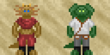
The human residents of the Viceroyalty, Carians are a strange people who are often viewed negatively abroad in the Empire, where some regard them as a cursed people. Rumors surround them and their heritage, which is lost to the modern historical record. Some Dominians believe all Carians are sorcerers who practice their vile witchery outside of the gaze of the Tribunal and Empire alike. Few serve in the Imperial military, and fewer serve the Tribunal outside of Caria, but they are highly successful merchants and traders across the Imperial Frontier and beyond, with most goods in the Sparring Sea-Badlands Region passing through Carian hands at least once. Some of their oldest mercantile families have trade networks stretching well beyond the Empire’s borders, and can acquire goods from as far afield as Assunzione or the Nralakk Federation if they so desire. A small minority of Dominians view the Carians as blessed heralds of the Goddess in the material world due to their strange appearances and the fact the planet produces a great number of Goddess-touched.
Genetically, Carians show deviation from baseline humanity in their appearance and some organs. Imperial scientists have noted Carians tend to recover more quickly from diseases when abroad compared to other Dominians. They tend to be extremely pale, though they do not burn as easily as their skin tone would indicate, and many appear to have sallow skin. Their hair tends towards darker colors – with most being black-haired – but colors such as silver, white, or blonde are not uncommon. Carian eye colors range beyond the normal human spectrum, with purple shades being relatively common – Grand Estate-Holder Kusarit Maharbal, for example, is known for her striking violet eyes and black hair. Their eyes have been modified or have adapted to see better in the constant semi-twilight of the planet, but are significantly more sensitive to rapid changes in light: flashes and flash grenades commonly used by police may temporarily blind them and most experience discomfort in normal light conditions. Carian eyes feature a larger iris and pupil than normal human eyes, and some wear sunglasses abroad to conceal this.
Oddly, the traits of “Carianism” – as it is known informally – appear to be highly genetically dominant and are always inherited by the child of a mixed non-Carian and Carian union.
While House Volvalaad is currently attempting to uncover the truth behind what makes Carians so divergent from baseline humanity, multiple theories have arisen to explain why Carians are so unusual. Most grounded are theories the manipulation comes from Carians themselves at some point in their past, or from the Solarian Alliance during its control of the planet. Neither of these theories, however, has any epigraphic or archeological evidence to support it. If documents do exist in the voluminous Solarian Department of Colonization archives covering genetic manipulation of Caria’s colonists, they have never been revealed by the Alliance or by researchers. Less grounded theories include Carians’ appearance comes from the Goddess Herself as punishment for a past sin or that they are not from the Spur at all, having arrived here from some alternate reality where humanity is slightly different.